
Reflective Practice
Portfolio
Exhibition
Location
RMIT Design Hub
Year
2025
An exhibition that explores the relationship between imagination and built forms.
A narrative where my works, either fragments of forms or spaces - are assembled and arranged for viewing and interaction. Each reveals a trace of how the imaginary is unpacked, from constraint to realisation and thought to possibility.

Each space represents a different stage of how my imagination operates within my process - from being bound by rules, to revealing form and spaces, and last to realisation.
Visitors can only enter through one point - the opening at the lower left. It forces movement in a single direction, guiding visitors through the same sequence that mirrors my own design process
A cage-like structure that both defines and restricts the path forward.
Imagination can only move within the boundaries allowed by these systems; the rules that I often set for myself. It’s about recognising that before imagination can expand, it must first learn to exist within limits.


This second room talks about the moment when imagination starts to take visible form.
This room frames the reveal as both an act
The curtain suggests as if imagination itself is stepping and taking over the stage.
Sensors detect pressure, and only when someone sits in the right seating spot does the curtain lift, unveiling what’s hidden.
This shows how new forms of imagination often come from shifting perspectives; how even a small change in position or viewpoint can uncover something entirely different.


My imaginary takes shape through modular system, metaphor or storytelling, literal forms and algorithmic logic

In this stage, imagination becomes habitable. If the previous room focused on form, this part looks at how imagination operates spatially.
Imagination expands into the environment, into how light, material, and geometry come together to create atmosphere and spatial experience.


Mirrors line the walls, multiplying every surface and form into an endless spatial illusion.
The space becomes an infinite loop, where boundaries of the rooms dissolve and perception expands. Each reflection reveals another layer of the imaginary, turning a single room into countless versions of itself.
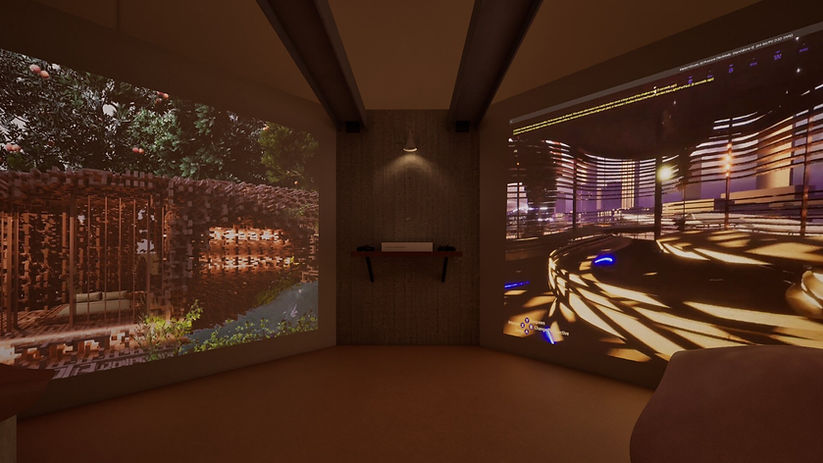
After passing through rules, form, and space, this stage captures how imagination can finally exist as architecture, through renderings and atmosphere.
Projected renders surround the viewer, immersing them inside the worlds that began as fragments of thought and form. Each wall becomes a window into the imagination, showing how ideas can be visualised, inhabited, and felt.
